Global Economic Outlook 2026: Growth, Risks, and the Forces Shaping the World Economy
The 2026 Global Economic Outlook: What to Expect
The world economy operates like an intricate network, shaped by dozens of variables that constantly influence one another. Looking ahead to 2026, economists from different institutions are landing on a similar estimate: global GDP growth of around 3.5%. It’s an encouraging figure at first glance, but one that sits alongside a fair amount of turbulence in financial markets. This article looks at the main forces behind that projection, the sources of instability that could reshape the picture, and what all of this means in practice for companies, governments, and everyday people.
Understanding this landscape isn’t just about memorizing a percentage. It requires looking at the forces working behind the scenes — geopolitical tension, technological progress, inflation trends, and monetary policy decisions. The years ahead are likely to bring deep changes, and the ability to adapt will be a decisive advantage.
Behind the Number: What Supports the 3.5% Projection
Most financial institutions and economic research centers are converging on this figure for global growth in 2026. It marks a slowdown compared to the sharp rebounds seen right after the pandemic, but it points to a return to a steadier, more sustainable pace of expansion.
What’s Driving This Growth
One central factor is the recovery — uneven as it may be — of the world’s major economies. Developed nations, having already absorbed much of the recent shocks, are expected to hold a stable pace, backed by strong labor markets and continuous technological innovation. Emerging markets, especially in Asia and parts of Africa, are likely to drive a large share of this global result, benefiting from demographic advantages, rapid urbanization, and expanding trade networks.
Breakthroughs in artificial intelligence, biotechnology, and renewable energy are also acting as important catalysts. They’re not just opening up new sectors and jobs — they’re boosting productivity across industries that already exist. Digitalization, accelerated by the pandemic, keeps reshaping business models and consumer habits, creating room for new forms of growth.
Public investment in infrastructure and green initiatives should also support this scenario. Many countries have committed to shifting toward cleaner economies, which involves substantial spending on sustainable energy, electric vehicle infrastructure, and resilient urban planning. These investments have a double effect: they stimulate economic activity in the short term while laying the groundwork for sustainable growth over the long run.
Regional Differences in Growth
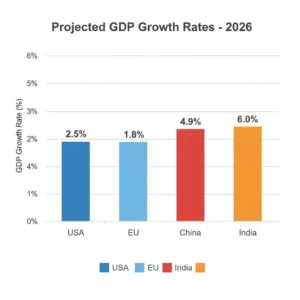
Even though the global average points to 3.5%, that number hides meaningful differences between regions. The United States, for example, is expected to post more moderate growth as fiscal stimulus effects fade and monetary policy returns to normal. The Eurozone, dealing with structural challenges and energy security concerns, may see a more modest performance, depending heavily on how geopolitical conflicts are resolved and how effective its green transition policies turn out to be.
China, historically one of the world’s main growth engines, should keep expanding, though at a more contained pace than in past decades, with a focus on domestic consumption and high-tech sectors. India, meanwhile, stands out as one of the fastest-growing major economies, powered by its large domestic market, young population, and ongoing economic reforms.
Other emerging markets — in Southeast Asia and Latin America, for instance — are also poised to grow, helped by diversified economies and deeper integration into global supply chains. Africa, with its abundant natural resources and expanding consumer base, holds significant long-term potential, even if its immediate contribution to 2026 global GDP is likely to be more concentrated in certain regions.
Market Volatility: The Risks Looming Over 2026
Despite optimistic growth forecasts, this outlook is closely tied to market volatility. That instability comes from a mix of factors — geopolitical tension, inflationary pressure, and shifts in monetary policy. Understanding these sources is essential for anyone trying to manage risk and spot opportunity.
Geopolitical Tension and Its Economic Fallout
International conflicts remain a major source of uncertainty. Trade disputes, wars, and shifting alliances can disrupt supply chains, push commodity prices around, and shake investor confidence. The conflict in Eastern Europe, for example, has already caused lasting effects on global energy and food markets, and its consequences are expected to extend into 2026. Tensions in other strategic regions could also intensify, further threatening the stability of the projected outlook.
Energy security remains a concern, since swings in oil and gas prices directly affect production costs and consumer purchasing power. Governments and businesses are increasingly looking to diversify their energy sources, but that transition is complex and prone to market disruptions.
Inflationary Pressure and Central Bank Responses
Inflation, which surged globally in recent years, is expected to ease but may stay above pre-pandemic levels in several economies. Supply chain bottlenecks, strong demand, and wage pressure all play a role. Central banks around the world have responded with aggressive rate hikes in an attempt to bring prices under control — and how effective those measures turn out to be will shape the direction of the global economy.
The challenge for central banks is to rein in inflation without triggering a deep recession. The path interest rates take should directly influence investment decisions, household spending, and overall economic performance. Any miscalculation could result in either persistent inflation or a downturn sharper than expected.
Financial Markets and Investor Sentiment
Global financial markets react quickly to economic news, regulatory shifts, and geopolitical events. Stock markets, bond yields, and exchange rates can swing sharply, creating both risk and opportunity. The relationship between inflation, interest rates, and corporate earnings should shape much of the market mood.
On top of that, the growing integration of global financial markets means shocks in one region spread quickly to others. This interconnection amplifies volatility, pushing investors toward diversified portfolios and more flexible strategies. The rise of digital assets and decentralized finance adds yet another layer of complexity to this picture.
Other Factors Shaping the Economic Landscape
Labor Markets and Wages
A healthy job market is the foundation of sustained growth. In several developed economies, unemployment has stayed low, which has pushed wages up. That’s good for consumer spending, but excessive wage growth can fuel inflation. Balancing full employment with price control will be one of the biggest challenges for policymakers.
Demographic shifts — aging populations in developed countries and a growing youth population in emerging markets — will also affect labor supply and demand. Automation and AI are reshaping the nature of work, creating new roles while phasing out others. Governments and educational institutions will need to prepare the workforce for these changes.
Supply Chains and Global Trade
The fragility of global supply chains became obvious during the pandemic and got worse amid geopolitical conflict. While efforts are underway to diversify sources and build more resilient chains, that’s a slow process requiring heavy investment. The trend toward bringing production closer to home (“reshoring”) or to allied countries (“friend-shoring”) could reshape global trade patterns, raising costs in the short term but adding security in the long run.
Trade policy — tariffs and agreements — will keep influencing the flow of goods and services. A shift toward more protectionism could hold back global growth, while renewed multilateral cooperation could give it a boost.
Debt Levels and Fiscal Sustainability
Public debt, which surged during the pandemic due to stimulus packages, remains a concern in many countries. High debt limits governments’ ability to respond to future shocks and can push interest rates higher. Keeping public finances sustainable will be a central challenge, requiring a balance between stimulating growth and controlling debt.
Corporate and household debt also deserve attention. While low rates in previous years encouraged borrowing, rising rates could increase the cost of servicing that debt, straining balance sheets and affecting investment and spending decisions.
Climate Change and the Energy Transition
Tackling climate change isn’t just an environmental issue — it’s an economic one too. The shift to a low-carbon economy brings both challenges and opportunities. Investment in renewable energy, sustainable agriculture, and resilient infrastructure should drive significant economic activity. On the other hand, the costs of decarbonization — including regulatory changes and stranded assets in fossil fuel industries — could also create headwinds.
Extreme weather events, growing more intense, cause significant economic damage, disrupting supply chains, destroying infrastructure, and hurting agricultural output. The financial sector is increasingly factoring climate risk into its investment decisions.
What This Means for Businesses, Governments, and Individuals
This scenario of moderate growth amid instability carries real consequences for different groups.
For Businesses: Adaptability Is Everything
Companies will need to prioritize flexibility and resilience. Diversifying supply chains, investing in automation and digital transformation, and building a skilled workforce will be key steps for weathering market swings. Businesses that can innovate and respond quickly to shifting consumer behavior and new technology will be best positioned to succeed.
Understanding regional nuances will also be essential for expansion strategies. Companies targeting high-growth emerging markets will need to adapt their offerings to local tastes and regulatory environments. Risk management — including hedging against currency and commodity price swings — will also become increasingly important.
For Governments: Strategic Decision-Making
Governments face the challenge of crafting policies that promote sustainable growth without losing control of inflation or public finances. Investment in education, infrastructure, and research will be essential for boosting long-term productivity. Striking the right balance between fiscal stimulus and consolidation will require a delicate touch.
International cooperation will also be crucial. Tackling global challenges — climate change, pandemics, geopolitical instability — requires coordinated action. Trade policies that keep markets open while ensuring fair competition will be critical for a healthy economic outlook.
For Individuals: Financial Prudence and Skill-Building
Individuals will need to adopt more financial caution, saving and investing wisely in a volatile environment. Spreading investments across different asset classes and geographies helps reduce risk. Ongoing skill development and lifelong learning will be essential for staying competitive in shifting job markets.
Understanding broader economic trends helps people make more informed decisions about career paths, housing, and personal finances. The ability to adapt to new technology and keep learning will be a real advantage.
The Role of International Cooperation
In an increasingly connected world, one country’s decisions ripple out to affect the rest of the globe. That’s why international cooperation isn’t just nice to have — it’s essential for a stable, prosperous global economy. From coordinating monetary and fiscal policy to jointly tackling challenges like climate change and pandemics, collective action can reduce risk and amplify positive outcomes.
Aligning Economic Policy
Central banks and finance ministries around the world face similar challenges: controlling inflation, encouraging growth, and ensuring financial stability. Greater coordination between monetary and fiscal policy can prevent beggar-thy-neighbor moves and reduce the risk of global shocks. Synchronized rate hikes, for instance, while necessary to fight inflation, can trigger currency volatility and capital flight from emerging markets if not carefully managed. Dialogue between major economic powers — through forums like the G7 and G20 — is essential for navigating these complexities.
Tackling Global Challenges Together
Many of the factors shaping this outlook are global by nature. Climate change, for example, requires a collective response to cut emissions and invest in adaptation measures. International agreements and financing mechanisms to support the green transition in developing countries are vital. Pandemics, as recent history has shown, can severely disrupt global supply chains and economic activity — which is why international cooperation on health security and vaccine distribution remains critical.
Geopolitical tensions also often have economic roots or consequences. Diplomatic efforts to resolve conflicts and build peaceful relations are essential for keeping trade routes stable, securing energy supplies, and maintaining investor confidence. A fragmented international order, marked by rising protectionism and nationalism, would clearly hurt the prospects for robust global growth.
Strengthening Multilateral Institutions
International organizations like the International Monetary Fund (IMF), the World Bank, and the World Trade Organization (WTO) play a central role in promoting global economic stability and cooperation. Strengthening these institutions, reforming them to reflect today’s geopolitical realities, and ensuring they function effectively are vital steps for addressing cross-border economic issues. They provide platforms for dialogue, financial assistance to countries in need, and rules for fair trade.
The WTO’s work to facilitate trade and resolve disputes, for example, is critical for keeping markets open — one of the biggest drivers of global growth. Likewise, the IMF’s monitoring of economic trends and its technical assistance help countries navigate challenges and adopt sound policy.
Risks That Could Change This Picture
While the 3.5% global GDP growth projection serves as a baseline, it’s important to recognize the risks that could throw this trajectory off course.
Escalating Geopolitical Conflict
A significant escalation of existing conflicts — or the emergence of new ones — represents the most immediate and severe risk. This could cause further disruptions to energy and food supplies, divert resources from productive investment toward defense spending, and erode consumer and investor confidence more broadly. The economic fallout from such events tends to be unpredictable and far-reaching.
Persistent Inflation and Tighter Monetary Policy
If inflation proves more stubborn than expected, central banks may be forced to tighten policy even more aggressively. That could lead to a sharper economic slowdown, pushing major economies toward recession. The risk of “stagflation” — high inflation paired with stagnant growth — remains a concern if supply-side issues go unresolved and demand destruction becomes the main tool for fighting inflation.
Financial Instability and Debt Crises
High levels of public and private debt, combined with rising interest rates, could trigger financial instability. Vulnerable countries or heavily leveraged companies may struggle to service their debts, potentially leading to defaults and broader financial contagion. A systemic financial crisis, while not the baseline scenario, remains a tail risk that could seriously hurt global growth and market stability.
New Global Health Crises
The possibility of new global health crises — whether from novel pathogens or the resurgence of known diseases — can’t be ruled out entirely. While the world is better prepared than it was at the start of the COVID-19 pandemic, a severe outbreak could still trigger new lockdowns, supply chain disruptions, and a meaningful economic slowdown.
Climate Disasters and Transition Risks
The growing frequency and severity of climate-related disasters — floods, droughts, wildfires, extreme storms — pose increasing economic risks. These events can destroy infrastructure, damage agriculture, displace populations, and drive up reconstruction costs. On top of that, a poorly managed green transition could also trigger economic shocks, particularly in industries heavily dependent on fossil fuels, leading to job losses and regional downturns.
Conclusion: Cautious Optimism for 2026
The outlook for 2026 points to a period of moderate growth, with analysts projecting a 3.5% increase in global GDP. That forecast rests on continued economic recovery, technological progress, and strategic government investment. But this optimism comes with a real dose of market instability, driven by geopolitical tension, persistent inflationary pressure, and shifting monetary policy.
For businesses, the focus should be on adaptability, diversification, and strategic innovation. Governments will need to design agile, sustainable policies while strengthening international cooperation to tackle shared challenges. Individuals, meanwhile, should prioritize financial prudence and ongoing skill-building to thrive in this dynamic environment.
The road to 2026 will undoubtedly bring both challenges and opportunities. The 3.5% growth projection offers an encouraging benchmark, but how global economies manage volatility, navigate emerging risks, and pursue collaborative solutions will ultimately determine the real shape of the world economy. Vigilance, resilience, and strategic foresight will define success in the years ahead.
Related Posts: